Introduction
A Big Five safari in Tanzania is one of East Africa’s most sought-after wildlife experiences. Tanzania offers the opportunity to search for the five animals traditionally known as the Big Five: lion, leopard, elephant, African buffalo and black rhinoceros.
The most practical route for travellers who want to see all five combines Tarangire National Park, the Ngorongoro Conservation Area and Serengeti National Park. Tarangire is particularly notable for its elephant concentrations, Ngorongoro is one of Tanzania’s strongest areas for black rhino sightings, while the Serengeti provides extensive predator habitat and exceptional opportunities to encounter lions and leopards.
However, seeing all five is never guaranteed. Wildlife is free-ranging, sightings depend on season, habitat, weather, animal movements and the time spent in the field.
For travellers planning a private safari, the key is therefore not simply choosing “Big Five” destinations. It is building an itinerary that gives you enough time in the right habitats.
What Are the Big Five in Tanzania?
The Big Five are:
- African lion
- African leopard
- African elephant
- African buffalo
- Black rhinoceros
The expression “Big Five” originally referred to five challenging and dangerous animals sought by big-game hunters. Modern photographic safaris use the term to describe five of Africa’s most iconic wildlife species.
Today, a Big Five safari is primarily about wildlife observation, photography and conservation, rather than hunting.
Tanzania is particularly attractive for Big Five enthusiasts because its northern safari circuit places several important wildlife ecosystems within one journey.
The Ngorongoro Conservation Area Authority confirms that the area supports all five species, including black rhinoceros, elephants, buffaloes, lions and leopards.
Where Can You See the Big Five in Tanzania?
The strongest Big Five safari circuit is generally built around:
| Destination | Big Five Strength | Why Visit |
|---|---|---|
| Serengeti National Park | Lion, leopard, buffalo, elephant, rhino | Vast plains, predators and migration |
| Ngorongoro Crater | Rhino, lion, buffalo, elephant, leopard | Extremely concentrated wildlife |
| Tarangire National Park | Elephant, buffalo, lion, leopard | Large elephant herds and baobabs |
| Lake Manyara National Park | Elephant, buffalo, lion, leopard | Compact wildlife viewing and tree-climbing lions |
| Ruaha National Park | Elephant, buffalo, lion, leopard | Remote southern wilderness and large herds |
| Mkomazi National Park | Rhino, elephant, buffalo, lion, leopard | Rhino-focused wildlife experience |
The best route depends on whether your priority is ticking off all five, photography, the Great Migration, fewer crowds, luxury accommodation or combining safari with Zanzibar.
1. Serengeti National Park: Big Cats and Endless Plains
The Serengeti National Park is one of Tanzania’s most important destinations for a Big Five safari.
Its enormous grassland ecosystem supports large populations of herbivores and predators. Lions are among the major attractions, while leopards can be encountered in areas with suitable cover, particularly around wooded riverine habitats.
The Serengeti is also central to the annual wildebeest migration, creating additional opportunities to observe predator-prey interactions.
For travellers specifically targeting the Big Five, spending more than one night in the Serengeti is worthwhile. A single game drive can produce memorable sightings, but additional time gives your guide more opportunities to follow changing wildlife movements.
Best for: lions, leopards, migration, photography and extended game viewing.
2. Ngorongoro Crater: One of Tanzania’s Best Big Five Areas
If your main objective is to maximise your chances of seeing several Big Five species in a relatively concentrated area, Ngorongoro Crater deserves a central place in your itinerary.
The crater is the world’s largest intact and unfilled volcanic caldera and supports a remarkably high concentration of wildlife. The Ngorongoro Geopark describes the crater as home to more than 25,000 animals, including the Big Five.
Black rhinoceros are one of the most important reasons to include Ngorongoro in a Big Five itinerary.
You may also encounter:
- Lions
- Buffalo
- Elephants
- Leopards
- Hippos
- Hyenas
- Zebras
- Wildebeest
- Gazelles
- Elands
The enclosed geography of the crater creates an exceptional wildlife-viewing environment, although sightings are still never guaranteed.
Best for: black rhino, concentrated wildlife viewing, first-time safari travellers and photography.
For additional planning information, see Bunuli’s guide to exploring Ngorongoro Crater.
3. Tarangire National Park: Tanzania’s Elephant Country
Tarangire is often added to Big Five itineraries because of its exceptional elephant viewing.
TANAPA describes the park as famous for large elephant concentrations and its iconic baobab landscapes. During the dry season, wildlife gathers around the Tarangire River and other remaining water sources.
The park also supports lions, leopards and buffalo, making it a valuable addition to a northern Tanzania safari.
Tarangire is particularly rewarding when combined with Ngorongoro and Serengeti rather than treated as a standalone Big Five destination.
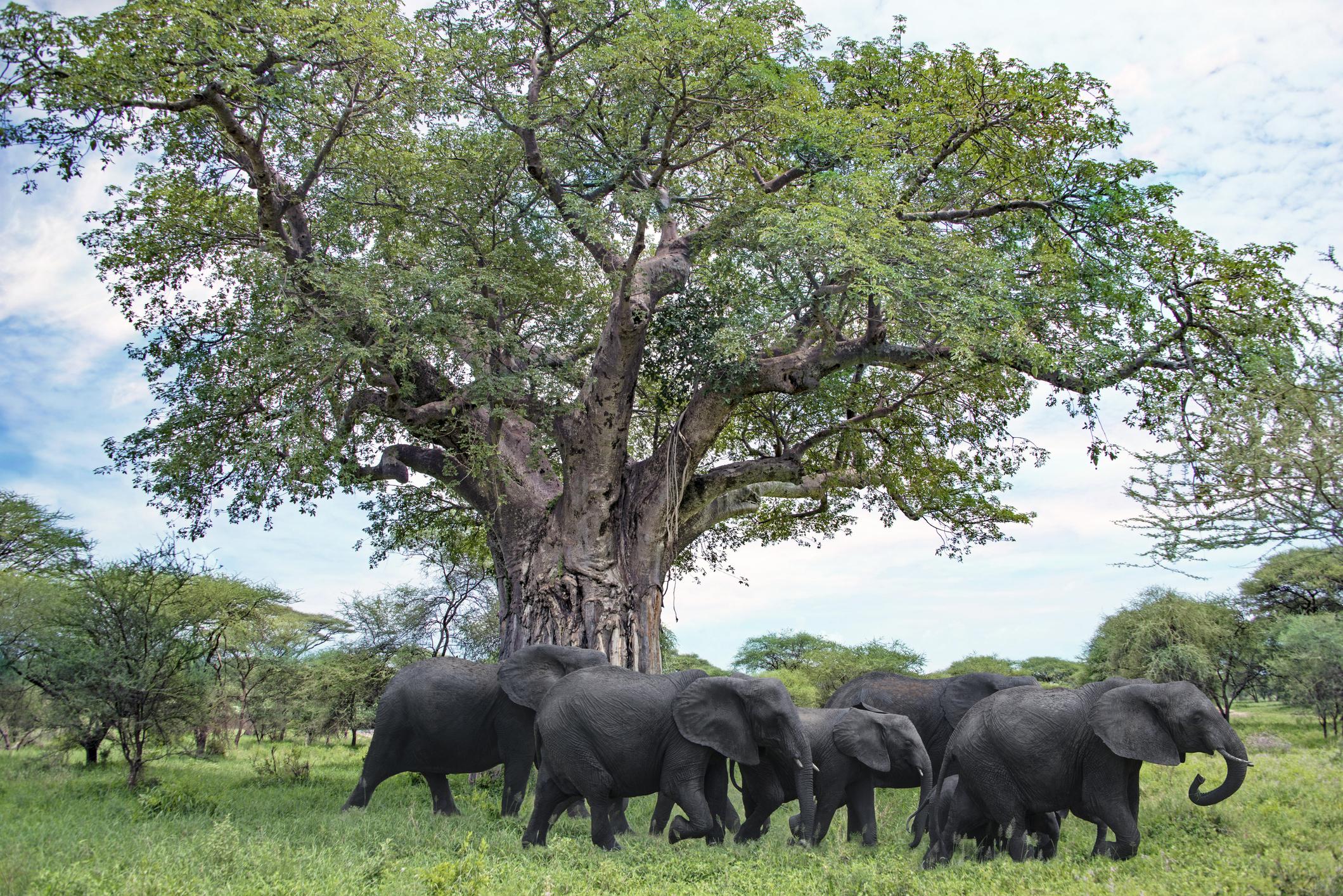
Best for: elephants, landscapes, photography, dry-season wildlife and a quieter northern-circuit experience.
4. Lake Manyara National Park: Elephants, Buffalo and Tree-Climbing Lions
Lake Manyara is not usually the first park travellers choose specifically to complete the Big Five, but it can add variety to a northern Tanzania safari.
TANAPA records elephants, buffalo, lions and leopards in the park, alongside the famous tree-climbing lions. The park also contains groundwater forests, wetlands, alkaline lake habitats and Rift Valley scenery.
This makes Manyara particularly useful for travellers who want more than a checklist of five animals.
You can combine game viewing with:
- Bird watching
- Canopy walks
- Rift Valley viewpoints
- Cultural experiences around Mto wa Mbu
- Photography
- Forest and wetland exploration
Best for: short game drives, elephants, tree-climbing lions, birds and varied landscapes.
5. Ruaha National Park: A Southern Tanzania Alternative
For travellers who want a more remote safari experience, Ruaha National Park provides an alternative to the northern circuit.
TANAPA identifies Ruaha as Tanzania’s second-largest national park, covering approximately 20,226 square kilometres. It is known for elephants, large buffalo herds, lions and leopards, with wildlife concentrating around rivers and water sources during the dry season.
Ruaha is especially interesting for repeat Tanzania visitors or travellers who want to explore beyond the classic Serengeti–Ngorongoro route.
It is also well suited to travellers interested in combining classic safari species with less commonly seen animals such as greater kudu, sable and African wild dogs.
Best for: remote wilderness, elephants, buffalo, lions, leopards and specialist safari experiences.
The Big Five in Tanzania: Animal-by-Animal Guide
African Lion
Lions are among the most frequently targeted Big Five animals on Tanzania safaris.
The Serengeti provides extensive lion habitat, while Ngorongoro’s concentrated wildlife ecosystem can also produce excellent sightings.
Early morning and late afternoon are generally productive periods because temperatures are cooler and predators are often more active.
African Leopard
Leopards are usually more difficult to find than lions because they are solitary, elusive and often use trees, rocky areas and dense vegetation for cover.
This is why leopard sightings reward patience.
If leopard photography is important to you, consider spending multiple nights in the Serengeti rather than moving between parks every day.
African Elephant
Elephants are among the easiest Big Five animals to associate with Tanzania’s northern circuit.
Tarangire is particularly famous for elephant concentrations, while elephants are also present in Serengeti, Ngorongoro, Manyara and other protected areas.
African Buffalo
Buffalo are widespread across Tanzania’s safari ecosystems.
They are commonly encountered in herds and can often be seen grazing in open grasslands or near water.
Ngorongoro is particularly useful for travellers building a compact Big Five itinerary because buffalo occur alongside several other target species.
Black Rhinoceros
The black rhinoceros is usually the most challenging Big Five animal for many travellers to find.
This makes Ngorongoro especially important for a northern Tanzania Big Five safari.
Tanzania’s official tourism information also identifies black rhino as one of the country’s major wildlife attractions.
Because rhino populations require careful protection, sightings should always be conducted responsibly and at the distance directed by guides and park authorities.
Best Time for a Big Five Safari in Tanzania
There is no single month that is perfect for every Big Five animal.
For general wildlife viewing, June to October is widely considered one of the strongest periods because vegetation is generally thinner and wildlife movements become easier to observe around remaining water sources.
June–October
Good for:
- General game viewing
- Elephants and buffalo around water
- Predator sightings
- Photography
- Dry landscapes
- Great Migration activity, depending on location and timing
January–March
This period can be particularly interesting in the Serengeti ecosystem because of the wildebeest calving season.
Predator activity can be excellent because young animals attract carnivores.
November–December
The short rains transform the landscape, bringing fresh vegetation and migratory movement.
April–May
The long rains can bring greener scenery and lower visitor numbers, although weather can affect road conditions and some safari logistics.
The right season depends on your safari objective rather than simply choosing the most popular month.
How Many Days Do You Need for a Big Five Safari in Tanzania?
For travellers starting around Arusha, a 5-day Tanzania Big Five safari can cover the essential northern circuit:
Day 1: Arusha → Tarangire
Day 2: Tarangire → Ngorongoro area
Day 3: Ngorongoro Crater → Serengeti
Day 4: Full-day Serengeti game drive
Day 5: Serengeti game drive → departure/Arusha or onward flight
However, a 7-day Big Five safari provides considerably more flexibility.
A practical 7-day structure is:
- Day 1 – Tarangire
- Day 2 – Tarangire/Ngorongoro
- Day 3 – Ngorongoro Crater
- Day 4 – Serengeti
- Day 5 – Serengeti
- Day 6 – Serengeti
- Day 7 – Serengeti → departure
The additional Serengeti nights are valuable if leopard sightings, photography and predator behaviour are major priorities.
For travellers with more time, a 9–10 day Tanzania safari allows a slower pace and the possibility of adding Lake Manyara, additional Serengeti sectors or cultural experiences.
Bunuli Safaris already offers Tanzania itineraries including a 9-Day Tanzania Safari covering Serengeti, Ngorongoro and Tarangire and a 16-Day Ultimate Tanzania Highlights Safari.
How Much Does a Big Five Safari in Tanzania Cost?
There is no single fixed price for a Tanzania Big Five safari.
Your final cost depends on:
- Number of travellers
- Safari duration
- Private or shared vehicle
- Lodge or tented-camp category
- Travel season
- Park fees
- Internal flights
- Guide and vehicle standards
- Special activities
- Serengeti location
- Number of nights inside the parks
As a result, a professionally planned private safari should be quoted according to the exact itinerary rather than advertised as one universal price.
For travellers comparing options, ask whether the quotation includes:
Accommodation + meals + private 4WD safari vehicle + professional guide + park/conservation fees + airport transfers + game drives + applicable taxes.
This prevents apparently cheap safari packages from becoming more expensive after essential items are added.
You can explore Bunuli’s Tanzania safari collection for different itinerary lengths and travel styles.
Private vs Group Big Five Safari in Tanzania
A private Big Five safari gives you greater control over your schedule.
You can spend longer at a leopard sighting, request an early start, adjust the pace and customise accommodation.
A shared safari can be useful for travellers who prefer a lower per-person cost and do not require complete control over the itinerary.
For photographers, families, honeymooners and travellers with specific wildlife priorities, itinerary flexibility can be particularly important.
What Makes a Good Big Five Safari Itinerary?
A strong itinerary should not simply list as many parks as possible.
Look for:
1. Enough time in each ecosystem
Constantly changing locations reduces the time available for wildlife viewing.
2. Strategic park selection
Tarangire, Ngorongoro and Serengeti complement each other exceptionally well.
3. Experienced guiding
A knowledgeable guide can interpret tracks, animal behaviour, habitats and recent sightings.
4. Appropriate accommodation
Your lodge or camp location can influence how much time you spend travelling to and from wildlife areas.
5. Flexible game drives
Private safaris allow greater flexibility around wildlife sightings.
6. Responsible wildlife viewing
Never request a guide to chase, corner or pressure animals for a photograph.
The objective is to observe wildlife without disturbing natural behaviour.
Big Five Safari Packing List for Tanzania
Bring:
- Neutral-coloured lightweight clothing
- Warm layers for early mornings
- Wide-brimmed hat
- Sunglasses
- Sunscreen
- Insect repellent
- Binoculars
- Camera and spare batteries
- Power bank
- Comfortable walking shoes
- Reusable water bottle
- Small daypack
- Lightweight rain jacket
- Personal medication
- Travel documents
A good pair of binoculars can significantly improve the experience, particularly when searching for leopards and distant rhinos.
Frequently Asked Questions About Big Five Safaris in Tanzania
Can you see all the Big Five in Tanzania?
Yes. Tanzania supports lion, leopard, elephant, buffalo and black rhinoceros. However, no ethical safari operator should guarantee that all five will be seen on a particular trip because they are wild animals and sightings are unpredictable.
Where is the best place to see the Big Five in Tanzania?
The answer depends on the animal. Ngorongoro is particularly valuable for black rhino and concentrated wildlife, Tarangire is renowned for elephants, and Serengeti offers extensive predator habitat. Combining the three creates a strong northern Tanzania Big Five itinerary.
Is Serengeti good for the Big Five?
Yes. Serengeti is an important Big Five destination, particularly for lions, leopards and buffalo, while elephants and rhinos also occur within the wider ecosystem.
Is Ngorongoro better than Serengeti for the Big Five?
They provide different experiences. Ngorongoro offers highly concentrated wildlife in a relatively compact area, while Serengeti provides a much larger ecosystem and more extensive opportunities to follow predators and migrating herbivores.
What is the best month for a Big Five safari in Tanzania?
For general dry-season wildlife viewing, June to October is a strong period. January to March can be particularly attractive for the Serengeti’s calving season. The ideal timing depends on the species and experience you want.
How many days are enough for a Tanzania Big Five safari?
Five days can cover the essential northern circuit, but seven days allows more time in the Serengeti and reduces the pressure to move between parks quickly.
Can I combine a Big Five safari with Zanzibar?
Yes. Tanzania makes it relatively straightforward to combine a northern safari with a Zanzibar beach holiday. A common structure is safari first, followed by several days on the coast.
Is Tanzania suitable for a luxury Big Five safari?
Yes. The northern circuit has a wide range of luxury lodges and tented camps. A private 4WD vehicle, premium accommodation, carefully selected camp locations and internal flights can be incorporated into a luxury itinerary.
Which Big Five animal is hardest to see in Tanzania?
Sightings vary, but black rhino and leopard can require more patience than elephants, buffalo or lions. This is one reason why longer itineraries can be advantageous.
Plan Your Big Five Safari in Tanzania with Bunuli Safaris
Seeing Tanzania’s Big Five is not simply about visiting a list of national parks. The quality of the experience depends on route design, timing, guide expertise, accommodation location, time spent in the field and realistic wildlife expectations.
For a classic northern Tanzania safari, Tarangire + Ngorongoro + Serengeti creates a powerful combination of elephant country, concentrated crater wildlife and expansive predator habitat.
For travellers who want to go deeper, additional nights in the Serengeti or an extension to southern Tanzania can create a more immersive safari.
Bunuli Safaris designs customised East African safari journeys around your preferred travel dates, accommodation level, interests and pace. The company currently offers Tanzania journeys as well as multi-country Uganda, Rwanda, Kenya and Tanzania itineraries.
Ready to plan your Tanzania Big Five safari?
Request a customised Tanzania safari itinerary from Bunuli Safaris and tell us your travel dates, number of travellers, preferred accommodation level and the wildlife experiences you want to prioritise.
Your safari should be designed around your time, interests and expectations—not a generic package.