Introduction
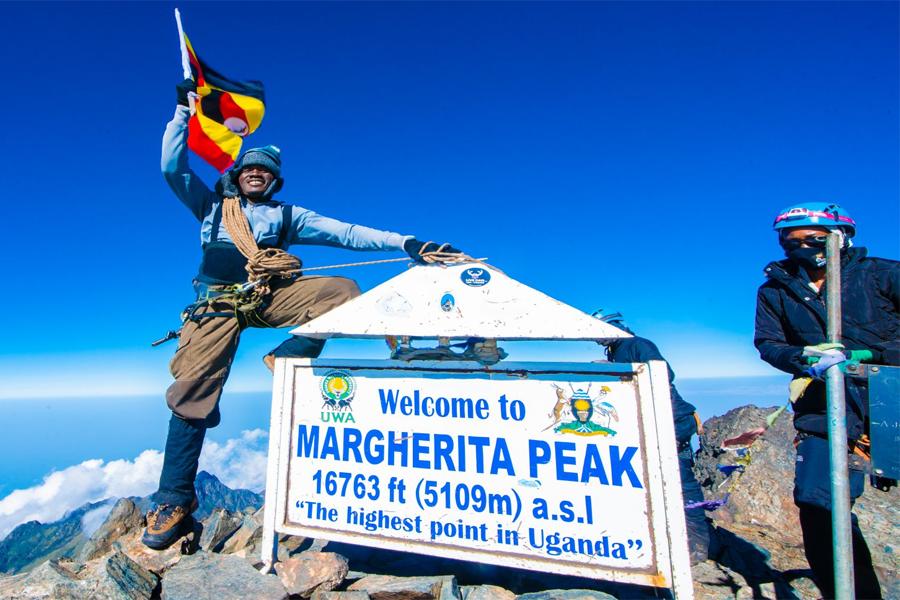
Rwenzori Mountains National Park is Uganda’s premier high-altitude trekking destination and home to the legendary Margherita Peak, the highest point in Uganda and one of Africa’s great mountain summits.
Known as the “Mountains of the Moon,” the Rwenzori Mountains rise dramatically along Uganda’s western border with the Democratic Republic of Congo.
Unlike a typical African safari destination, Rwenzori Mountains National Park is experienced primarily on foot.
The journey takes trekkers through a remarkable sequence of ecosystems—from cultivated foothills and montane forest to bamboo, giant heathers, alpine vegetation, bogs, rocky valleys and glacial landscapes.
The mountain’s extraordinary ecological diversity is what makes a Rwenzori trek in Uganda so different from climbing a conventional high-altitude peak.
For adventurous travelers, the experience isn’t only about reaching the summit.
It is about the entire journey.


Rwenzori Mountains National Park at a Glance
| Feature | Details |
|---|---|
| Country | Uganda |
| Region | Western Uganda |
| Mountain range | Rwenzori Mountains |
| UNESCO status | Rwenzori Mountains are a UNESCO World Heritage Site |
| Highest peak | Margherita Peak |
| Mountain | Mount Stanley |
| Main activity | Mountain trekking |
| Other activities | Hiking, birding, nature walks and cultural experiences |
| Famous landscapes | Forest, bamboo, giant heathers, alpine vegetation and glaciers |
| Main trekking areas | Nyakalengija/Central Circuit and Kilembe |
| Recommended trek | 7–9 days for a summit-focused itinerary |
| Best for | Adventure travelers, hikers, climbers and photographers |
Rwenzori Mountains National Park protects approximately 996 square kilometres of spectacular mountain terrain.
The range contains several major peaks, with Margherita Peak on Mount Stanley reaching approximately 5,109 metres above sea level.
Where Is Rwenzori Mountains National Park?
Rwenzori Mountains National Park is located in western Uganda, near the town of Kasese and the border with the Democratic Republic of Congo.
The park is part of the larger Rwenzori mountain system.
Its proximity to Queen Elizabeth National Park makes it possible to combine mountain trekking with a traditional wildlife safari.
A popular western Uganda combination is:
Kampala → Queen Elizabeth National Park → Rwenzori Mountains
or:
Rwenzori Mountains → Queen Elizabeth → Kibale → Bwindi
This makes the Rwenzori Mountains an excellent addition to a longer Uganda adventure.
Why Are the Rwenzori Mountains Called the Mountains of the Moon?
The Rwenzori Mountains have long been associated with the ancient geographical descriptions of the “Mountains of the Moon.”
The phrase has become closely associated with the mountain range’s dramatic landscapes, permanent or seasonal snow and glaciers, mist-covered valleys and enormous alpine vegetation.
The mountain environment feels remarkably different from the savannah landscapes elsewhere in Uganda.
Within a single trek, you can move through:
tropical forest → bamboo → montane forest → giant heather → alpine zone → rock and ice.
That extraordinary ecological transition is one of the defining characteristics of a Rwenzori expedition.
Margherita Peak: The Highest Point in Uganda
Margherita Peak is the highest point in Uganda, rising to approximately 5,109 metres above sea level on Mount Stanley.
It is one of the three principal summits of Mount Stanley, alongside Alexandra and Albert.
Reaching Margherita Peak is a serious mountaineering achievement.
It requires:
- Good physical fitness
- Proper acclimatization
- Appropriate clothing
- Technical equipment
- Experienced guides
- Careful route planning
- Preparation for rapidly changing weather
- Comfort with high-altitude conditions
This is not a casual day hike.
Travelers searching for “how difficult is Margherita Peak?” should understand that the summit expedition involves multiple days of trekking and demanding alpine terrain.


How Difficult Is Rwenzori Trekking?
Rwenzori trekking ranges from moderate hiking to highly demanding high-altitude mountaineering, depending on the route and summit objective.
A short nature or lower-elevation trek is considerably easier than climbing Margherita Peak.
A summit expedition involves:
- Long trekking days
- Significant elevation gain
- Muddy and wet trails
- Steep sections
- Rocky terrain
- Alpine vegetation
- Cold temperatures
- Possible snow and ice
- Altitude-related challenges
The biggest mistake is treating Rwenzori trekking like an ordinary safari activity.
Preparation matters.
You should train for endurance, elevation gain, carrying a daypack and prolonged walking on uneven terrain.
Rwenzori Trekking Routes
There are several approaches to exploring the Rwenzori Mountains.
The two most commonly discussed trekking systems are:
Central Circuit
Associated with the Nyakalengija approach and historically operated through the classic Central Circuit route.
Kilembe Route
The Kilembe Trail provides another major approach into the Rwenzori mountains and is particularly known for its dramatic scenery and wilderness character.
Your choice depends on:
- Trek duration
- Summit objective
- Fitness
- Experience
- Scenery preferences
- Operator availability
- Current route conditions
A professional safari operator should recommend the route based on your ability and objectives, rather than simply selling the longest itinerary.
Rwenzori Central Circuit
The Central Circuit is one of the classic ways to experience the Rwenzori Mountains.
A typical trek passes through different ecological zones before reaching higher alpine terrain.
Trekkers may encounter:
- Montane forest
- Bamboo
- Giant heathers
- Alpine vegetation
- Lobelia
- Senecio
- Valleys
- High-altitude lakes
- Rocky ridges
- Glacial landscapes
The route is as much an ecological expedition as it is a mountain climb.
Kilembe Trail
The Kilembe Trail offers a spectacular alternative route into the Rwenzori Mountains.
The trail is particularly attractive to hikers who want:
- Remote mountain scenery
- Dramatic valleys
- Alpine vegetation
- High-altitude landscapes
- A challenging multi-day trek
It can also be used for summit-oriented expeditions depending on the itinerary and current mountain conditions.
Rwenzori Mountains Ecosystems
One of the strongest reasons to visit the Rwenzori Mountains is the extraordinary ecological succession.
Montane Forest
Lower elevations contain dense forest with birds, primates and abundant vegetation.
Bamboo Zone
As elevation increases, bamboo becomes more prominent.
Heather Zone
Giant heathers create some of the most unusual scenery on the mountain.
Alpine Zone
Higher elevations become increasingly open, with giant lobelias and senecios creating the distinctive Rwenzori landscape.
High-Altitude Rock and Ice
Near the highest peaks, vegetation gives way to rocky terrain, snow and glacial environments.
This progression makes Rwenzori trekking feel like several landscapes in one expedition.
Wildlife in Rwenzori Mountains National Park
Although Rwenzori is primarily a mountain destination, it supports wildlife within its forests and lower ecosystems.
Potential sightings include:
- Blue monkeys
- Black-and-white colobus monkeys
- Red duikers
- Hyraxes
- Forest elephants in the wider ecosystem
- Various small mammals
However, wildlife should not be the main reason for visiting.
If your priority is large mammals, choose Queen Elizabeth, Murchison Falls, Kidepo or Lake Mburo.
If your priority is mountain scenery, ecological diversity and trekking:
Rwenzori is exceptional.
Birdwatching in Rwenzori Mountains National Park
The mountain’s forests support an impressive range of birds.
Birders may encounter species associated with the Albertine Rift and montane habitats.
Potential sightings include:
- Rwenzori turaco
- Olive pigeon
- Mountain buzzards
- Sunbirds
- Flycatchers
- Barbets
- White-starred robin
- Various forest species
The Rwenzori turaco is particularly attractive to birdwatchers visiting the mountain.
For serious birders, combining Rwenzori with Bwindi Impenetrable National Park creates an excellent Albertine Rift birding itinerary.
Best Time to Climb the Rwenzori Mountains
The drier seasons are generally preferred for Rwenzori trekking, although weather in the mountains can change rapidly at any time of year.
The commonly favored periods are:
June–August and December–February.
During these periods, trekking conditions are often more favorable, although rainfall remains possible.
June–August
Generally considered one of the better trekking windows.
December–February
Another popular period for mountain expeditions.
March–May
Generally wetter and potentially more challenging because of rain and muddy trails.
September–November
Conditions can also be wetter, although experienced trekkers may still undertake expeditions.
There is no completely guaranteed dry season on the Rwenzori.
Mountain weather is unpredictable, and trekkers should prepare for rain, cold, wind and changing conditions regardless of the month.
How Many Days Do You Need to Climb Rwenzori?
The answer depends on your goal.
2–3 Days
Suitable for shorter lower-mountain hikes and introductory experiences.
4–5 Days
Can provide a deeper mountain experience without necessarily targeting the highest summit.
6–7 Days
Suitable for more serious trekking and acclimatization-focused itineraries.
7–9 Days
A multi-day summit expedition is generally the better choice for travelers targeting Margherita Peak.
The additional days provide more time for acclimatization and for adapting to the mountain environment.
10+ Days
Longer itineraries can provide additional acclimatization and a more gradual expedition depending on the route.
Don’t choose the shortest itinerary simply because it is cheaper.
On a high-altitude mountain, adequate acclimatization can be more important than saving a day.
Sample 8-Day Rwenzori Margherita Peak Trek
A detailed itinerary should always be adapted to the selected route and current operator/park conditions.
Day 1: Kampala/Entebbe → Kasese
Travel toward Kasese and prepare for the mountain expedition.
Overnight in Kasese.
Day 2: Trailhead → Mountain Camp
Begin trekking into the Rwenzori ecosystem.
The landscape changes progressively as you gain elevation.
Day 3: Higher Mountain Zone
Continue through forest and bamboo toward higher elevations.
Day 4: Alpine Environment
Enter the distinctive giant-heather and alpine zones.
The landscape becomes increasingly dramatic.
Day 5: High-Altitude Camp
Continue toward the upper mountain and prepare for the summit section.
Day 6: Margherita Peak Summit Attempt
Begin early for the summit.
This is the most demanding stage of the expedition and requires appropriate technical equipment, guides and careful assessment of weather and conditions.
Day 7: Descent
Begin descending through the mountain’s changing ecological zones.
Day 8: Exit and Return to Kasese/Kampala
Complete the descent and transfer onward.
Actual camp names, distances, timings and summit schedules vary according to route and operator.
Rwenzori Trekking Cost
The cost of a Rwenzori trek depends on route, duration, group size, summit objective, accommodation, guides, porters, equipment and transport.
A professional quotation may include:
- Park fees
- Trekking permits/fees
- Guides
- Porters
- Accommodation during the trek
- Meals
- Transfers
- Safety equipment
- Summit support
- Pre- and post-trek accommodation
Additional costs may apply for:
- Equipment rental
- Extra hotel nights
- Private transfers
- Personal porter
- Travel insurance
- Tips
- Additional activities
Because mountain fees and operator rates can change, request a current quotation based on your travel dates rather than relying on an old online price.
Bunuli Safaris can build the trek according to your preferred duration, route and accommodation level.
What Is Included in a Rwenzori Trek?
Before paying a deposit, ask your operator exactly what is included.
A transparent Rwenzori trekking package should clearly explain:
Transport + park/trek fees + guides + porters + accommodation + meals + summit support + safety arrangements.
It should also state what you must provide yourself.
This is especially important for high-altitude trekking because equipment requirements can significantly affect the final cost.
What to Pack for Rwenzori Mountains Trekking
Packing correctly is critical.
You should consider:
Clothing
- Moisture-wicking base layers
- Fleece
- Warm jacket
- Waterproof jacket
- Waterproof trousers
- Trekking trousers
- Thermal layers
- Warm hat
- Gloves
- Several pairs of hiking socks
Footwear
- Waterproof hiking boots
- Camp shoes
- Gaiters
Trekking equipment
- Backpack
- Sleeping bag suitable for cold conditions
- Headlamp
- Trekking poles
- Water bottles or hydration system
- Dry bags
- Backpack rain cover
Personal items
- Sunscreen
- Sunglasses
- Lip balm
- Personal medication
- Toiletries
- Power bank
- Camera
- Binoculars
High-altitude equipment
The exact equipment required for a Margherita Peak summit should be confirmed with your trekking operator.
Technical equipment may be required depending on current glacier and summit conditions.
Do not assume ordinary hiking equipment is sufficient for a summit attempt.
Altitude and Acclimatization on the Rwenzori
Altitude is one of the most important considerations when planning a Rwenzori expedition.
Margherita Peak rises above 5,000 metres, meaning trekkers are exposed to significant altitude.
Symptoms of altitude-related illness can include:
- Headache
- Nausea
- Dizziness
- Fatigue
- Shortness of breath
- Loss of appetite
Proper acclimatization is therefore essential.
A responsible trekking itinerary should allow the body time to adjust.
Trekkers should communicate symptoms to guides immediately.
Never continue upward simply because you have paid for the summit.
Mountain safety must come first.
Rwenzori Mountains vs Mount Kilimanjaro
Travelers often compare Rwenzori with Mount Kilimanjaro.
They are very different experiences.
| Feature | Rwenzori | Kilimanjaro |
|---|---|---|
| Country | Uganda | Tanzania |
| Highest point | Margherita Peak | Uhuru Peak |
| Experience | Wilderness trekking | High-altitude trekking |
| Landscape | Extremely diverse ecosystems | Diverse ecological zones |
| Technical sections | Can be technical | Generally non-technical summit route |
| Weather | Often wet and unpredictable | Often comparatively drier |
| Glacial environment | Present | Present but retreating |
| Crowds | Generally fewer | Much busier |
| Main appeal | Remote mountain wilderness | Africa’s highest mountain |
Choose Rwenzori if you want a more remote, wild and technically demanding mountain experience.
Choose Kilimanjaro if your primary goal is reaching Africa’s highest summit through a more established trekking system.
Rwenzori vs Mount Elgon
Uganda also offers Mount Elgon National Park, another excellent hiking destination.
Rwenzori is the stronger choice for:
- High-altitude trekking
- Margherita Peak
- Alpine landscapes
- Glaciers
- Serious mountain expeditions
Mount Elgon is better suited to travelers wanting:
- Long-distance hiking
- Volcanic landscapes
- Caldera scenery
- Lower-altitude trekking
- A different type of mountain adventure
Can You Combine Rwenzori With a Uganda Safari?
Yes—and this is one of the best ways to experience western Uganda.
A strong itinerary could be:
Kampala → Rwenzori Mountains → Queen Elizabeth National Park → Kibale → Bwindi
This combines:
Mountains + wildlife + chimpanzees + gorillas.
Another excellent combination is:
Rwenzori → Queen Elizabeth → Bwindi → Lake Bunyonyi
This works particularly well for travelers who want adventure followed by relaxation.
Rwenzori + Queen Elizabeth National Park
This is one of the most logical combinations.
After several days trekking in the mountains, you can descend into the savannah landscape of Queen Elizabeth National Park.
Enjoy:
- Game drives
- Tree-climbing lion search in Ishasha
- Kazinga Channel boat cruise
- Elephants
- Buffaloes
- Hippos
- Antelopes
It creates a dramatic contrast between Uganda’s high mountains and lowland wildlife.
Rwenzori + Kibale Chimpanzee Trekking
For primate enthusiasts, add Kibale National Park after the mountain trek.
Your itinerary becomes:
Rwenzori Mountains → Kibale Forest
You move from high-altitude alpine ecosystems into one of Africa’s richest primate forests.
Add chimpanzee tracking and the experience becomes one of Uganda’s most diverse adventure combinations.
Rwenzori + Bwindi Gorilla Trekking
For the ultimate Uganda adventure, combine:
Rwenzori trekking + gorilla trekking.
This is particularly attractive for experienced travelers who want a physically active holiday.
The journey combines:
- Margherita Peak
- Alpine trekking
- Mountain forests
- Gorilla trekking
- Albertine Rift scenery
Because both activities are physically demanding, sufficient recovery time should be included.
Is Rwenzori Mountains National Park Worth Visiting?
Absolutely—especially for travelers looking for an alternative to conventional African safaris.
Rwenzori is not simply another mountain.
Its combination of:
altitude + biodiversity + glaciers + giant vegetation + remote valleys + cultural heritage
creates an experience unlike almost anywhere else in Africa.
And unlike a safari where the vehicle does much of the work, Rwenzori demands something from you.
You walk.
You climb.
You adapt.
You slow down.
And the mountain reveals itself gradually.
That is the attraction.
Who Should Trek the Rwenzori Mountains?
Rwenzori is particularly suitable for:
- Experienced hikers
- Adventure travelers
- Mountaineers
- Landscape photographers
- Nature enthusiasts
- Birdwatchers
- Fitness-focused travelers
- Travelers seeking less crowded mountain experiences
It is less suitable for travelers looking for an easy holiday.
If you want a relaxed Uganda experience, consider combining a short Rwenzori nature walk with a safari rather than attempting Margherita Peak.
Responsible Tourism in the Rwenzori Mountains
Responsible trekking protects both the mountain environment and the communities around it.
Travelers should:
- Stay on designated trails
- Follow guide instructions
- Avoid littering
- Carry out non-biodegradable waste
- Avoid damaging vegetation
- Respect wildlife
- Use authorized guides
- Respect local communities
- Support legitimate local tourism
- Avoid removing rocks, plants or natural materials
- Follow park conservation regulations
Porters are an important part of the trekking economy.
Travelers should choose operators that maintain fair and ethical porter practices and provide suitable working conditions.
Frequently Asked Questions About Rwenzori Mountains National Park
Where is Rwenzori Mountains National Park?
It is located in western Uganda near Kasese and the border with the Democratic Republic of Congo.
What is Rwenzori Mountains National Park famous for?
It is famous for the Mountains of the Moon, Margherita Peak, alpine landscapes, giant vegetation, glaciers and multi-day mountain trekking.
What is the highest mountain in Uganda?
Mount Stanley’s Margherita Peak is the highest point in Uganda at approximately 5,109 metres.
How difficult is Margherita Peak?
Margherita Peak is a serious high-altitude mountaineering objective requiring good fitness, acclimatization, appropriate equipment and experienced guides.
How many days does it take to climb Rwenzori?
A summit-focused expedition commonly requires around 7–9 days, although the exact duration depends on route, acclimatization strategy and trekking operator.
v
June–August and December–February are commonly preferred trekking periods, although mountain weather can be unpredictable throughout the year.
Is Rwenzori harder than Kilimanjaro?
The answer depends on the route and objective, but Rwenzori can involve wetter, muddier and more technically demanding terrain, particularly on summit routes.
Can beginners climb Rwenzori?
Beginners can participate in shorter or lower-altitude Rwenzori hikes, but a Margherita Peak expedition requires substantially more preparation and physical fitness.
Are there glaciers in the Rwenzori Mountains?
Yes. The high Rwenzori peaks contain glacial terrain, although the glaciers have experienced significant long-term retreat.
Can I see wildlife in Rwenzori?
Yes, particularly in the forest and lower mountain zones, although Rwenzori is primarily a trekking destination rather than a conventional wildlife safari.
Can I combine Rwenzori with a safari?
Yes. Rwenzori combines particularly well with Queen Elizabeth National Park, Kibale National Park and Bwindi Impenetrable National Park.
How much does a Rwenzori trek cost?
Prices vary according to route, duration, group size, accommodation, guides, porters, transport and summit requirements. Request a current customized quotation rather than relying on outdated prices.
Do I need a guide for Rwenzori?
For organized trekking and summit attempts, travelers should use authorized and experienced mountain guides and follow current park and operator requirements.
What should I pack for Rwenzori trekking?
Warm layers, waterproof clothing, waterproof hiking boots, gloves, hat, sleeping equipment, trekking poles, headlamp, water system and appropriate high-altitude equipment are among the essentials.
Plan Your Rwenzori Mountains Trek With Bunuli Safaris
The Rwenzori Mountains offer a side of Uganda that many safari travelers never experience.
Beyond the savannahs and primate forests is a world of misty mountain valleys, giant lobelias, enormous heathers, rocky ridges, glaciers and Africa’s remarkable high-altitude landscapes.
Whether your ambition is:
a short Rwenzori hike,
a multi-day mountain trek,
or
the summit of Margherita Peak,
the itinerary should be designed around your fitness, experience, preferred route and available time.
Bunuli Safaris can combine your Rwenzori adventure with Queen Elizabeth National Park, Kibale, Bwindi, Lake Bunyonyi or other destinations in Uganda.
Ready to climb the Mountains of the Moon?
Request a customized Rwenzori Mountains trekking itinerary from Bunuli Safaris.
Tell us your preferred travel dates, number of travelers, trekking experience, desired route and whether you want to attempt Margherita Peak, and we can design the expedition around your goals.