Introduction
Dian Fossey Rwanda is more than a historical story. It is an opportunity to understand the origins of modern mountain gorilla conservation and visit the landscape where Fossey carried out her pioneering research.
In 1967, American primatologist Dr. Dian Fossey established the Karisoke Research Centre in the Virunga Mountains of Rwanda. The name Karisoke came from the two mountains between which she established her research station: Mount Karisimbi and Mount Bisoke.
Today, travellers visiting Rwanda can learn about Fossey’s legacy at the Ellen DeGeneres Campus of the Dian Fossey Gorilla Fund, visit the Volcanoes National Park area, and undertake the demanding hike toward the historic site of her grave and the former Karisoke research area.
For travellers interested in gorilla trekking, conservation, primatology, Rwanda history and meaningful cultural experiences, adding a Dian Fossey experience to a Rwanda safari can provide important context before or after trekking with mountain gorillas.
Who Was Dian Fossey?
Dian Fossey was an American zoologist and primatologist who became internationally recognised for her long-term study of mountain gorillas in Rwanda.
She arrived in the Virunga Mountains in 1967, establishing a small research camp between Mount Karisimbi and Mount Bisoke. Her research focused on understanding gorilla behaviour, social relationships and conservation.
At the time, mountain gorillas faced severe pressures, including habitat disturbance and poaching.
Fossey’s work helped bring international attention to the conservation needs of the species and established a research tradition that continues through the Karisoke Research Center and the Dian Fossey Gorilla Fund.
The Fossey Fund describes Karisoke as the world’s longest-running site of continuous mountain gorilla research. Its long-term scientific work has contributed substantially to understanding gorilla behaviour and conservation.
Why Is Dian Fossey Important to Rwanda’s Gorilla Conservation?
Fossey’s importance is closely connected to the development of long-term mountain gorilla research and protection.
Her work helped establish the idea that protecting gorillas requires more than simply protecting the animals themselves. Their forest habitat, surrounding communities, research, monitoring and anti-poaching efforts all matter.
The conservation model that developed around Karisoke has continued beyond Fossey’s lifetime.
The Dian Fossey Gorilla Fund currently describes its work as combining direct gorilla protection, scientific research, conservation education and support for communities around gorilla habitats.
Rwanda’s tourism authorities also connect tourism revenue with conservation and community benefits. Visit Rwanda states that a portion of gorilla permit revenue is directed toward communities around Volcanoes National Park.
What Is the Karisoke Research Centre?
The Karisoke Research Centre was founded by Dian Fossey in 1967 between Mount Karisimbi and Mount Bisoke.
The name combines:
Kari — Karisimbi
soke — Bisoke
Fossey originally established the research station with two small tents before developing it into a long-term centre for gorilla research.
Karisoke’s scientific legacy remains important today.
The Fossey Fund’s long-term research has generated extensive information about mountain gorilla behaviour, ecology and conservation and has contributed to hundreds of scientific publications.
This makes the Karisoke story particularly relevant to travellers who want to understand why gorilla trekking exists and how modern gorilla conservation developed.
Where Is Dian Fossey’s Grave?
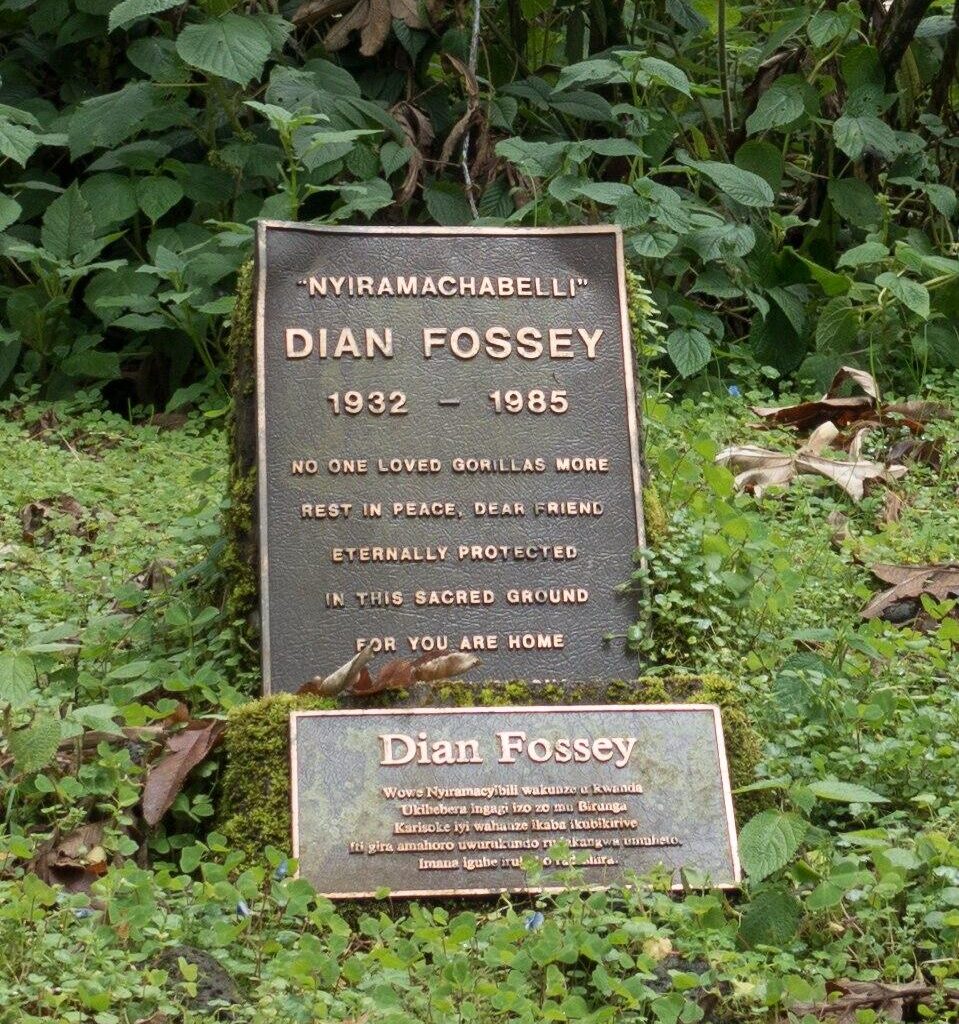
Dian Fossey’s grave is located in the Volcanoes National Park area of northern Rwanda, close to the historic Karisoke research site.
Visit Rwanda describes the Karisoke Research Centre and Fossey’s grave as being in the saddle between Mount Karisimbi and Mount Bisoke. The official hiking information gives the Karisoke route a duration of approximately three hours, with the walk itself taking around one to one-and-a-half hours after the drive from the park headquarters.
Fossey was buried beside Digit, a mountain gorilla she had studied closely and whose death became an important part of her conservation story.
The grave site is located at high altitude in a mountainous forest environment, so this is not a casual sightseeing stop.
It is a genuine hiking experience.
Dian Fossey Grave Hike


The Dian Fossey grave hike is one of the most meaningful historical experiences available around Volcanoes National Park.
The hike takes you into the mountainous landscape where Fossey conducted her research.
According to Visit Rwanda, the route begins with a drive of approximately 30 minutes from the park headquarters, followed by a hike through the forest. The overall Karisoke hike is listed at approximately three hours.
What makes the hike special?
It combines:
- History
- Conservation
- Mountain scenery
- Forest hiking
- Gorilla research history
- Primatology
- Dian Fossey’s legacy
Rather than simply visiting a monument, travellers experience part of the environment where Fossey spent years studying mountain gorillas.
How Difficult Is the Dian Fossey Hike?
The hike should be treated as moderate to strenuous, depending on current trail conditions, altitude and your fitness.
The route reaches elevations above 3,000 metres, according to Visit Rwanda’s gorilla-tracking information.
Expect:
- Steep terrain
- Mud during wet weather
- Uneven forest paths
- High altitude
- Variable weather
- Slippery sections
The experience is therefore more suitable for travellers comfortable with hiking than for visitors looking for a short sightseeing excursion.
What should you wear?
Visit Rwanda recommends:
- Sturdy hiking shoes
- Gaiters
- Strong clothing
- Lightweight waterproof jacket
- Gloves where useful
These recommendations are particularly important because Volcanoes National Park is a high-altitude rainforest environment where conditions can change quickly.
Dian Fossey Ellen DeGeneres Campus
For travellers who want to learn about Dian Fossey without undertaking the grave hike, the Ellen DeGeneres Campus of the Dian Fossey Gorilla Fund provides an accessible alternative.
The campus is located near Kinigi and the Volcanoes National Park headquarters.
The Fossey Fund says the campus includes:
- Conservation gallery
- Interactive exhibits
- Dian Fossey’s forest cabin replica
- Original artefacts
- Virtual reality experience
- 360-degree theatre
- Nature trails
The campus opened in 2022 and has welcomed visitors from Rwanda and around the world.
This makes it an excellent addition to a Rwanda gorilla trekking itinerary.
How Much Does the Dian Fossey Campus Cost?
The Fossey Fund’s published visitor information states that self-guided visits have a recommended donation of US$20.
It also notes that the campus is open daily from 9:00 a.m. to 5:00 p.m., with last entry at 4:00 p.m. The organisation also offers special behind-the-scenes tours and evening experiences by advance booking.
Because visitor arrangements can change, travellers should confirm the latest visitor information before travelling.
Dian Fossey Campus vs Dian Fossey Grave Hike
These are two different experiences.
| Experience | Dian Fossey Campus | Dian Fossey Grave Hike |
|---|---|---|
| Physical difficulty | Easy | Moderate–strenuous |
| Main focus | Education & conservation | History & hiking |
| Location | Near Kinigi | Virunga mountain forest |
| Time required | Short visit | Several hours |
| Original artefacts | Yes | Historic site |
| Forest hiking | Nature trails | Mountain trek |
| Grave visit | No | Yes |
| Suitable before gorilla trek | Excellent | Good for fit hikers |
| Best for | All travellers | Hikers & history enthusiasts |
For many travellers, the campus is the easiest introduction to Dian Fossey, while the grave hike provides a much deeper physical connection with her former research environment.
Can You Visit Dian Fossey Before Gorilla Trekking?
Yes.
In fact, the Ellen DeGeneres Campus can be particularly useful before your gorilla trek because it introduces you to:
- Mountain gorilla behaviour
- Conservation challenges
- Dian Fossey’s research
- Gorilla habitat
- The work of trackers and conservationists
The Fossey Fund specifically notes that visiting the campus before a gorilla trek can help visitors understand the gorillas and enrich their forest experience.
Dian Fossey and Gorilla Trekking in Rwanda
Dian Fossey’s legacy is inseparable from Rwanda’s modern gorilla tourism story.
Today, Volcanoes National Park protects Rwanda’s portion of the Virunga Mountains, a high-altitude ecosystem containing mountain gorillas and golden monkeys.
Gorilla trekking is highly regulated.
Visit Rwanda currently states that:
- Eight visitors can track a gorilla group per day.
- Gorilla encounters are limited to one hour.
- Visitors must be at least 15 years old.
- Treks can take anywhere from approximately 30 minutes to more than four hours depending on the location of the gorilla family.
- Porters are available to assist visitors.
The current international gorilla permit price listed by Visit Rwanda is US$1,500 per person per day.
This makes it possible to combine:
Dian Fossey Campus + Gorilla Trekking + Volcanoes National Park
into one conservation-focused Rwanda experience.
Dian Fossey and the Film Gorillas in the Mist
Dian Fossey’s work became internationally known through her book Gorillas in the Mist, which documented her experiences studying mountain gorillas.
The story later reached a much larger global audience through the film adaptation.
For many travellers, the film is the reason they first become interested in Rwanda’s mountain gorillas.
Visiting Volcanoes National Park provides an opportunity to move beyond the story presented on screen and understand the real conservation landscape in which Fossey worked.
What Happened to Dian Fossey?
Dian Fossey was murdered at her research camp in Rwanda in 1985.
Her death remains one of the most discussed episodes in the history of mountain gorilla conservation.
The circumstances surrounding her murder have been the subject of extensive historical discussion. For an SEO travel page, however, it is important not to present disputed theories about responsibility as established fact.
What is documented is that Fossey died in December 1985 and was buried at her research site next to Digit and other gorillas.
Her conservation work continued through the organisation that became the Dian Fossey Gorilla Fund.
Dian Fossey’s Legacy Today
Fossey’s influence extends well beyond her original research.
The Dian Fossey Gorilla Fund currently works in Rwanda and the Democratic Republic of Congo, focusing on:
- Gorilla protection
- Scientific research
- Biodiversity
- Conservation education
- Community development
- Training future conservationists
The organisation states that it now employs hundreds of people across Rwanda and the Democratic Republic of Congo as part of its conservation programmes.
The conservation story also demonstrates why community participation is essential to wildlife protection.
Mountain gorillas share their wider ecosystem with people who depend on surrounding land and natural resources. Long-term conservation therefore requires relationships between conservation organisations, government, tourism businesses and local communities.
Dian Fossey and the Growth of Mountain Gorilla Numbers
The history of Rwanda’s mountain gorillas is also a conservation success story, although the species remains endangered.
Visit Rwanda currently reports that the global mountain gorilla population has risen to just over 1,000, with 604 in the Virunga Massif according to its cited population figures.
The Fossey Fund similarly describes mountain gorilla numbers as increasing and attributes this to decades of protection and conservation work.
This is one reason the Dian Fossey story remains relevant today.
It is not simply history.
It connects directly to the continuing work required to protect the gorillas travellers come to Rwanda to see.
Best Time to Visit Dian Fossey in Rwanda
The Dian Fossey experience can be undertaken throughout the year, but weather conditions matter particularly for the grave hike.
June–September
These months generally provide favourable conditions for hiking in Rwanda’s mountain areas.
December–February
Another relatively favourable period for outdoor activities.
March–May
Rain can make mountain trails wetter and more challenging.
October–November
Shorter rains can also affect trail conditions.
For the Ellen Campus, weather is much less important because most of the experience is accessible without a long mountain hike.
How to Include Dian Fossey in a Rwanda Safari
Option 1: Campus + Gorilla Trekking
Day 1: Kigali
Day 2: Kigali → Musanze + Ellen DeGeneres Campus
Day 3: Gorilla trekking
Day 4: Golden monkey trekking or cultural experience → Kigali
This is the easiest option.
Option 2: Dian Fossey Hike + Gorilla Trekking
Day 1: Kigali → Musanze
Day 2: Dian Fossey/Karisoke hike
Day 3: Gorilla trekking
Day 4: Kigali
This is better suited to active travellers interested in conservation history.
Option 3: Complete Rwanda Wildlife Safari
Kigali → Akagera → Volcanoes → Dian Fossey Campus → Gorilla Trekking → Nyungwe → Lake Kivu
This creates a broader Rwanda itinerary combining:
- Big Five wildlife
- Mountain gorillas
- Primates
- Rainforest
- Conservation
- Culture
- Lakes
- Hiking
How Much Does a Dian Fossey Rwanda Experience Cost?
There isn’t one universal price because there are several ways to experience Dian Fossey’s legacy.
Ellen DeGeneres Campus
The Fossey Fund’s published information gives a recommended US$20 donation for self-guided visits.
Dian Fossey Grave / Karisoke Hike
The cost depends on the applicable hiking permit, guide, transport and whether the experience is included within a wider safari package.
Visit Rwanda’s hiking information states that the hike can be booked through Rwanda’s tourism booking system or through a tour operator.
Gorilla Trekking + Dian Fossey
The gorilla permit is currently US$1,500 for an international visitor, before accommodation, transportation and other safari services.
Therefore, a Dian Fossey experience should be priced as part of your complete Rwanda itinerary, rather than assuming that one fixed “Dian Fossey tour price” applies to everyone.
Is the Dian Fossey Experience Worth Adding to a Rwanda Safari?
For travellers interested in gorillas, conservation, history and hiking, it adds context that a conventional game drive cannot provide.
The Ellen Campus is particularly convenient because it can be visited around a gorilla trek without committing to a demanding mountain hike.
The grave hike is more immersive but requires greater physical effort.
The choice therefore depends on your:
- Fitness
- Available time
- Interest in conservation history
- Travel budget
- Gorilla trekking plans
- Hiking experience
Frequently Asked Questions About Dian Fossey Rwanda
Who was Dian Fossey?
Dian Fossey was an American primatologist who established the Karisoke Research Centre in Rwanda in 1967 and became internationally known for her long-term research and conservation work with mountain gorillas.
Where is Dian Fossey’s grave?
Her grave is in the Volcanoes National Park area, near the former Karisoke Research Centre between Mount Karisimbi and Mount Bisoke.
Can tourists visit Dian Fossey’s grave?
Yes. The site can be reached through a mountain hike, subject to current park regulations, guide arrangements and trail conditions.
How long is the Dian Fossey hike?
Visit Rwanda lists the Karisoke Research Centre hike at approximately three hours, including the approach described in its hiking information.
Is the Dian Fossey hike difficult?
It requires hiking through mountainous terrain at high altitude and can be challenging, especially in wet conditions.
Where is the Dian Fossey Museum in Rwanda?
The modern visitor experience is provided at the Ellen DeGeneres Campus of the Dian Fossey Gorilla Fund, near Kinigi. It features conservation exhibits, a replica of Fossey’s cabin, original artefacts, virtual reality and a 360-degree theatre.
How much does the Dian Fossey Campus cost?
The Fossey Fund’s published information gives a recommended US$20 donation for self-guided visits.
Can I visit the Dian Fossey Campus before gorilla trekking?
Yes. It is particularly suitable before a gorilla trek because it provides background on gorilla conservation and Fossey’s research.
Is Dian Fossey’s grave inside Volcanoes National Park?
The grave and historic Karisoke site are located in the Volcanoes mountain area associated with the park; access is through the regulated hiking system.
Can children do the Dian Fossey experience?
The campus is the more accessible option for families. Gorilla trekking itself has a minimum age of 15 in Rwanda.
Can I combine Dian Fossey with gorilla trekking?
Yes. This is one of the most natural combinations for a Rwanda gorilla safari.
Plan a Dian Fossey & Rwanda Gorilla Safari with Bunuli Safaris
A Rwanda gorilla safari can be much more meaningful when you understand the conservation history behind the experience.
At Bunuli Safaris, we can incorporate the Dian Fossey experience into a tailor-made Rwanda itinerary based on your interests, travel dates, budget and fitness level.
Your itinerary can combine:
- Dian Fossey Ellen Campus
- Dian Fossey grave hike
- Gorilla trekking
- Golden monkey trekking
- Volcanoes National Park
- Kigali
- Akagera National Park
- Nyungwe Forest
- Lake Kivu
- Bigogwe
- Uganda–Rwanda cross-border travel
Ready to Explore Dian Fossey’s Rwanda?
Contact Bunuli Safaris to design a Rwanda itinerary that combines gorilla trekking with Dian Fossey’s conservation legacy, Volcanoes National Park and the other experiences you want to discover.