Hot Air Balloon Safari in Kenya and Tanzania
A hot air balloon safari in Kenya or Tanzania is one of the most memorable ways to experience East Africa’s wildlife landscapes. Instead of watching the savannah from a safari vehicle, you rise before sunrise and float silently above grasslands, rivers, forests and wildlife as the first light spreads across the horizon.
The best-known balloon experiences are found in the Maasai Mara in Kenya and the Serengeti in Tanzania, although balloon safaris are also available in selected areas such as Amboseli, Ndutu and Tarangire, depending on the operator and season.
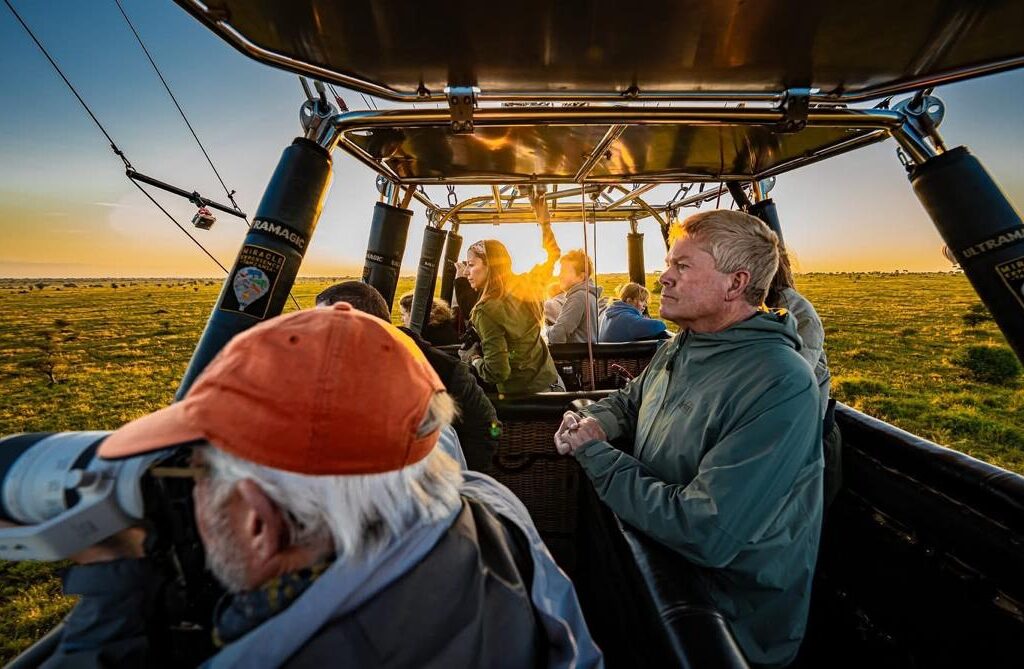
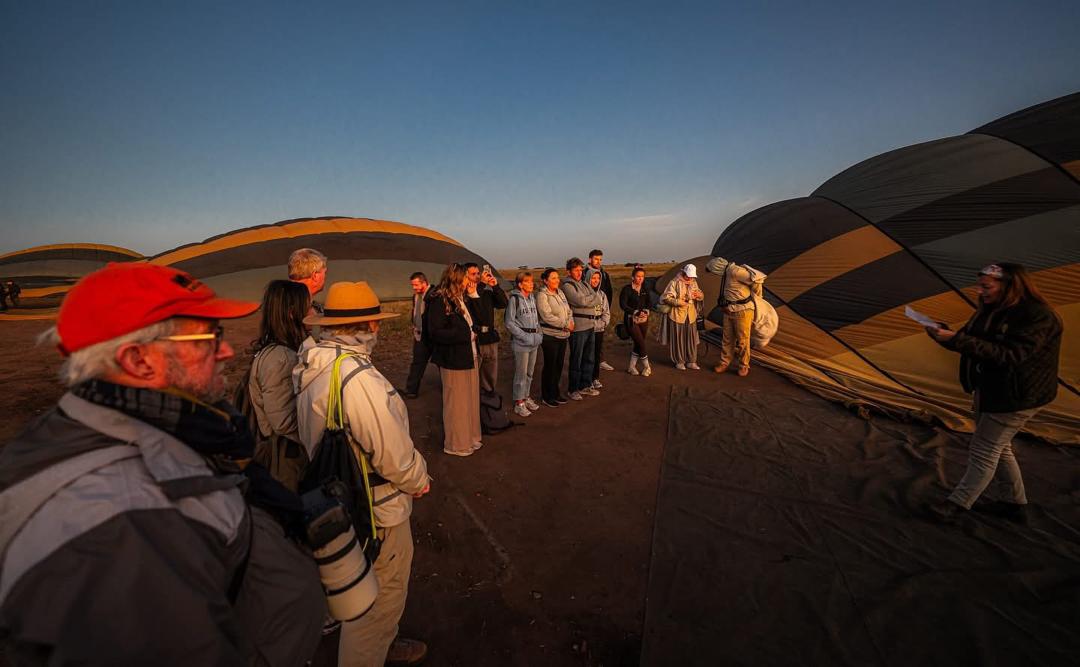
Most flights follow a similar pattern: an early-morning collection from your lodge or camp, transfer to the launch site, a safety briefing, a sunrise flight lasting roughly 45–60 minutes, followed by a bush breakfast or champagne-style celebration and onward transfer to continue your safari.
- Best for the classic African balloon safari: Maasai Mara
- Best for vast landscapes and the Great Migration: Serengeti
- Best for a short Kenya luxury add-on: Maasai Mara
- Best for combining multiple Tanzania safari regions: Serengeti or Tarangire
- Typical 2026 shared-flight price: approximately US$499 in the Maasai Mara and US$599 in the Serengeti, depending on operator, location and package.
What Is a Hot Air Balloon Safari?
A hot air balloon safari is a sunrise wildlife experience conducted from a basket suspended beneath a heated balloon.
Unlike a game drive, the balloon does not follow roads or fixed tracks. The flight direction and altitude depend on wind conditions and pilot decisions.
This gives travelers a completely different perspective of the African wilderness.
Depending on the location and conditions, you may fly:
- Close above the grasslands
- Over rivers and woodland
- High above the savannah
- Above migrating wildebeest herds
- Over elephant and giraffe habitat
- Across vast open plains at sunrise
Wildlife sightings are never guaranteed because animals move freely, but experienced operators in the Maasai Mara report that flights commonly offer opportunities to see species such as elephants, giraffes, zebras, gazelles, hyenas and ostriches, with predators sometimes spotted as well.
Where Can You Go on a Balloon Safari in Kenya?
1. Maasai Mara — Kenya’s Best Balloon Safari Destination


The experience combines three of Africa’s most powerful travel elements:
- Sunrise over the savannah
- Wildlife viewing from the air
- A bush breakfast after landing
The Maasai Mara’s open landscapes make it particularly suitable for aerial wildlife viewing. Depending on the season and flight path, passengers may see herds moving across the plains, wildlife around rivers and, during the migration period, concentrations of wildebeest.
Balloon Safaris Kenya, one of the long-established operators in the region, has been operating in the Maasai Mara since 1976 and describes typical flights as covering roughly 8–12 kilometres, depending on wind conditions.
What does a Maasai Mara balloon safari include?
Most packages include:
- Early-morning lodge or camp collection
- Transfer to the launch site
- Safety briefing
- Approximately one-hour balloon flight
- Bush breakfast
- Sparkling-wine or champagne-style celebration
- Ground transfer after landing
Exact inclusions depend on the operator.
Best for:
- First-time balloon safari travellers
- Honeymooners
- Couples
- Luxury safari travellers
- Great Migration safaris
- Photography enthusiasts
- Special occasions
2. Amboseli — Ballooning with Kilimanjaro Views
Amboseli offers a different type of balloon experience.
While the Maasai Mara is famous for its endless plains and migration drama, Amboseli is associated with its elephant herds and views toward Mount Kilimanjaro.
Some specialist operators currently list balloon flights in Amboseli, making it a valuable option for travellers looking for a less conventional Kenya balloon safari.
The main attraction is the combination of:
- Elephants
- Open landscapes
- Acacia woodland
- Kilimanjaro scenery when conditions allow
“Hot air balloon safari Amboseli with Mount Kilimanjaro views.”
How Much Does a Hot Air Balloon Safari Cost in Kenya?
Prices vary by operator, location and whether the experience is shared or private.
Current 2026 operator rate information shows:
- Maasai Mara: approximately US$499 per person with Adventures Aloft.
- Other Maasai Mara experiences currently advertise prices from around US$480–US$490 per person.
Private balloon experiences cost significantly more.
For example, one 2026 rate card lists a private Maasai Mara balloon at US$4,990 for up to eight passengers.
Important: Always confirm the final price when booking because balloon rates, park fees, camp transfers and private-flight pricing can change.
Where Can You Go on a Balloon Safari in Tanzania?
1. Serengeti National Park — Tanzania’s Ultimate Balloon Safari


If the Maasai Mara is Kenya’s iconic ballooning destination, the Serengeti is Tanzania’s ultimate aerial safari landscape.
The scale of the Serengeti is its greatest advantage.
From the air, travelers can appreciate the enormous size of the ecosystem in a way that is impossible from ground level.
Flights operate from different areas depending on the time of year and migration patterns.
Current Serengeti Balloon Safaris information lists flights from:
- Central Serengeti: throughout the year
- Western Corridor: June–October
- Northern Serengeti: June–October
- Ndutu: late December–March
This creates a major planning advantage: travelers can choose a balloon location based on where they are staying and where wildlife concentrations are expected to be.
2. Central Serengeti — Best Year-Round Option
The Central Serengeti, particularly around Seronera, is the most reliable choice for travelers visiting outside the seasonal migration areas.
Balloon flights in the region operate throughout the year.
Best for:
- First-time Serengeti visitors
- Year-round safari planning
- Big-cat safaris
- Luxury Tanzania itineraries
- Travelers with limited time
3. Northern Serengeti — Best for the Migration Season
Northern Serengeti balloon flights generally operate during the northern migration period.
This is a high-value experience for travelers hoping to combine:
- Wildebeest migration viewing
- River landscapes
- Open savannah
- Aerial photography
Current operator information lists northern Serengeti flights seasonally from approximately June through October or November, depending on the operator and operating area.
Because migration timing is influenced by rainfall and animal movement, no operator can guarantee a specific river crossing or exact wildlife event.
4. Ndutu — Best for the Calving Season
Ndutu is one of the most exciting areas for travelers following the Great Migration during the green season.
Balloon flights operate seasonally, generally from late December through March.
This is a strong SEO opportunity around keywords such as:
- Ndutu balloon safari
- Great Migration balloon safari Tanzania
- Serengeti calving season balloon safari
- Hot air balloon during wildebeest calving season
5. Tarangire — Tanzania’s Underrated Balloon Safari
Tarangire is an overlooked balloon-safari opportunity.
The park is particularly famous for:
- Large elephant herds
- Baobab trees
- Seasonal wildlife concentrations
- Diverse landscapes
A current 2026 operator rate card lists Tarangire balloon flights throughout the year.
For travellers already following Tanzania’s northern safari circuit, Tarangire can offer an alternative to the more frequently discussed Serengeti balloon experience.
How Much Does a Hot Air Balloon Safari Cost in Tanzania?
For 2026, current operator information shows Serengeti shared balloon flights around:
US$599 per person.
One private Serengeti balloon option is currently listed at approximately:
US$5,500 for up to eight passengers.
Packages commonly include:
- Early-morning collection
- Transfer to launch site
- Balloon flight
- Professional pilot and crew
- Bush breakfast
- Post-flight celebration
- Return transfer to continue the safari
Always confirm whether park fees are included separately in your overall Tanzania safari package.
Kenya vs Tanzania Hot Air Balloon Safari: Which Is Better?
| Feature | Kenya | Tanzania |
|---|---|---|
| Most famous location | Maasai Mara | Serengeti |
| Typical shared 2026 price | Around US$480–499 | Around US$599 |
| Best for short safari | Maasai Mara | Central Serengeti |
| Great Migration | July–October often popular | Seasonal locations follow migration |
| Year-round option | Selected locations | Central Serengeti |
| Best hidden opportunity | Amboseli | Tarangire |
| Best for huge landscapes | Excellent | Outstanding |
| Best for honeymoon luxury | Excellent | Excellent |
Choose Kenya if:
- You are visiting the Maasai Mara
- You have a shorter safari itinerary
- You want the classic East African balloon experience
- You are combining Nairobi and the Maasai Mara
- You are travelling on a slightly tighter balloon budget
Choose Tanzania if:
- You want the vastness of the Serengeti
- You are following the Great Migration
- You want to choose balloon locations based on migration movements
- You are combining Serengeti with Ngorongoro, Tarangire and Lake Manyara
- You want a longer Tanzania safari
What Time Does a Balloon Safari Start?
A balloon safari starts very early in the morning.
Collection from your camp may be around 4:00–5:00 a.m., depending on the distance from the launch site.
The reason is simple: balloon flights are scheduled around suitable morning conditions and sunrise.
A typical Maasai Mara itinerary, for example, includes pre-dawn collection, sunrise launch, approximately one hour of flying, breakfast in the bush and a return transfer or game drive.
How Long Is a Hot Air Balloon Flight?
The actual flight generally lasts around:
45 minutes to 1 hour.
However, the complete experience usually takes approximately 4–5 hours, including:
- Pick-up
- Transfer
- Briefing
- Balloon inflation
- Flight
- Landing
- Breakfast
- Return transfer
Official Kenya Tourism Board experience information currently describes the Maasai Mara activity as approximately four hours, including a roughly one-hour flight and bush breakfast.
Is a Hot Air Balloon Safari Safe?
Balloon safaris are conducted by licensed pilots and specialist ground crews, with flights dependent on weather conditions.
For example, Balloon Safaris Kenya states that its equipment undergoes annual safety inspections by the Kenyan Civil Aviation Authority.
Operators can cancel flights if weather conditions are unsuitable.
This is an important point for travellers:
Never schedule your balloon safari on the morning of a critical international departure.
If possible, book the experience early enough in your itinerary to allow flexibility if a flight is postponed or cancelled.
Who Can Go on a Balloon Safari?
Requirements vary by operator.
Some current operators specify minimum ages between 5 and 7 years, while restrictions may apply to:
- Young children
- Pregnant travelers
- Travelers with serious mobility limitations
- Passengers who exceed specified weight limits
One 2026 operator rate card specifies a minimum age of five and minimum height requirements, while another Maasai Mara operator recommends against participation for children under seven, pregnant guests and those with severe mobility limitations.
Always confirm the specific operator’s requirements before booking.
What Should You Wear on a Balloon Safari?
Early mornings in East African safari destinations can feel surprisingly cold.
We recommend:
- Light jacket or fleece
- Comfortable trousers
- Closed shoes
- Hat or cap
- Sunglasses
- Camera or smartphone
- Extra battery or power bank
Layered clothing works best because temperatures usually become warmer after sunrise.
Avoid bringing unnecessarily large bags into the balloon basket.
Is a Hot Air Balloon Safari Worth the Money?
For many travelers, yes.
A balloon safari is expensive compared with a standard game drive, but it provides an experience that cannot be replicated from a safari vehicle.
You are paying for:
- Specialist equipment
- Licensed aviation personnel
- Ground crew
- Logistics
- Small passenger capacity
- Early-morning operations
- Aerial access to wilderness landscapes
- Breakfast and transfers, depending on the package
It is particularly worth considering for:
- Honeymoons
- Anniversaries
- Milestone birthdays
- Photography trips
- Luxury safaris
- First-time Africa travellers
- Great Migration safaris
If your budget is limited, prioritize your core safari activities first and treat ballooning as a premium upgrade.
Best Time for a Hot Air Balloon Safari in Kenya
The Maasai Mara offers balloon flights throughout much of the year, subject to weather and operator availability.
Best time for the Great Migration
Generally, July to October is the period most associated with migration activity in the Maasai Mara.
However, wildlife movements are influenced by rainfall, and exact migration events cannot be guaranteed.
Best for fewer crowds
Outside the busiest migration period, travellers may still enjoy excellent wildlife viewing and balloon conditions.
Best for photography
Early-morning light is one of the biggest advantages of ballooning, regardless of season.
Best Time for a Hot Air Balloon Safari in Tanzania
Tanzania offers more location-specific seasonality.
Central Serengeti
Available throughout the year.
Ndutu
Typically, late December to March.
Best for:
- Calving season
- Large wildebeest concentrations
- Predator activity
Western Corridor
Generally, June to October.
Northern Serengeti
Generally, June to October or November, depending on the operator.
Tarangire
Some operators currently offer flights throughout the year.
Hot Air Balloon Safari and the Great Migration
A balloon safari can be one of the most spectacular ways to experience the Great Migration, but travellers should avoid assuming that booking a balloon flight guarantees a river crossing.
The migration is a natural movement involving huge herds responding to:
- Rainfall
- Grazing conditions
- Water availability
- Seasonal movement patterns
The smarter booking strategy is:
- Choose your Tanzania or Kenya travel dates.
- Identify where the migration is most likely to be during that period.
- Select accommodation in the correct region.
- Book the balloon safari from the operating area closest to your camp.
This is why Tanzania can be particularly flexible: balloon operations in Central Serengeti, Ndutu, Western Corridor and Northern Serengeti can align with different safari seasons.
Hot Air Balloon Safari for Honeymoons and Special Occasions
A balloon safari is one of the strongest luxury and honeymoon conversion opportunities for East African safari packages.
It works especially well when combined with:
- Private safari vehicles
- Luxury tented camps
- Bush breakfasts
- Private dinners
- Serengeti honeymoon packages
- Maasai Mara honeymoon safaris
- Zanzibar beach extensions
- Ngorongoro Crater experiences
For a honeymoon itinerary, we recommend placing the balloon flight in the first half of the safari, allowing flexibility if weather causes cancellation.
Recommended Kenya Balloon Safari Itinerary
4-Day Maasai Mara Balloon Safari
Day 1: Nairobi to Maasai Mara
Day 2: Morning and afternoon game drives
Day 3: Sunrise hot air balloon safari + bush breakfast + game drive
Day 4: Return to Nairobi
Recommended Tanzania Balloon Safari Itinerary
6-Day Tanzania Safari with Balloon Flight
Day 1: Arrival in Arusha
Day 2: Tarangire National Park
Day 3: Ngorongoro Conservation Area
Day 4: Transfer to Serengeti
Day 5: Sunrise Serengeti balloon safari + wildlife game drive
Day 6: Departure or extension
Frequently Asked Questions About Balloon Safaris in Kenya and Tanzania
How much does a hot air balloon safari cost in Kenya?
Current 2026 Maasai Mara shared-flight prices are generally around US$480–499 per person, depending on the operator and package.
How much does a hot air balloon safari cost in Tanzania?
A shared Serengeti balloon safari is currently advertised at around US$599 per person by major operators, although prices can vary.
Is a balloon safari included in a normal safari package?
Usually, no. It is commonly offered as an optional premium activity, although tailor-made luxury packages can include it.
How long does the balloon flight last?
Most flights last approximately 45 minutes to one hour, depending on wind and conditions.
What is better: Maasai Mara or Serengeti balloon safari?
Choose the Maasai Mara for a classic, compact Kenya experience. Choose the Serengeti for enormous landscapes and the ability to align your balloon experience with different migration regions.
Can children go on a hot air balloon safari?
Possibly, depending on the operator. Minimum ages currently vary, with examples ranging from five to seven years. Always confirm before booking.
Can pregnant women fly?
Many operators restrict or do not recommend balloon flights for pregnant travellers because of the physical nature of landing. Confirm directly with the operator before booking.
What happens if the weather is bad?
Flights can be delayed or cancelled for safety reasons. Cancellation and refund policies vary by operator.
Book a Kenya or Tanzania Balloon Safari with Bunuli Safaris
A balloon safari should fit naturally into your itinerary rather than being added randomly.
At Bunuli Safaris, we can help you choose the right ballooning destination based on:
- Your travel dates
- Migration movements
- Safari route
- Accommodation location
- Budget
- Travel style
- Whether you are planning a honeymoon, family trip or luxury safari
We can incorporate a balloon safari into tailor-made:
- Kenya safari packages
- Maasai Mara safaris
- Tanzania wildlife safaris
- Serengeti Great Migration tours
- Kenya and Tanzania combined safaris
- Luxury honeymoon safaris
- Private East African itineraries
Planning a Kenya or Tanzania safari with a balloon ride? Contact Bunuli Safaris with your travel dates, number of travellers and preferred accommodation level, and we can design an itinerary around the best ballooning location for your journey.